


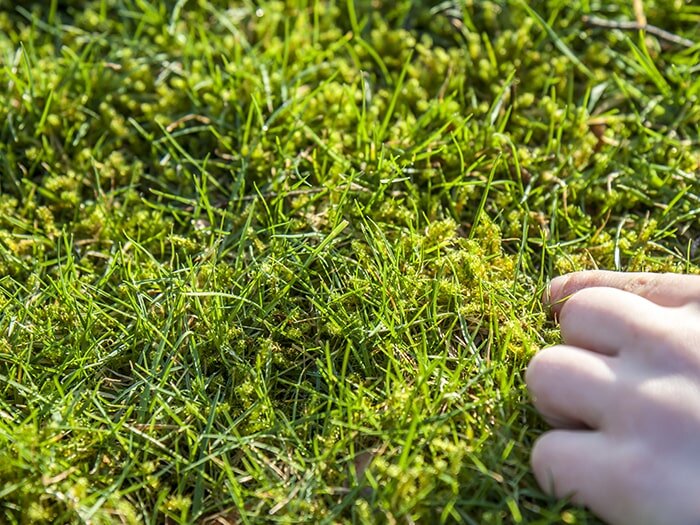
Moss gets a bad rap. Sure, it can take a beautiful lawn and turn it into a patchy mess. But you might be surprised to learn that it really isn’t the moss that is at fault. It’s the circumstances.
 Moss is an opportunistic plant. Lack of nutrients, low soil pH, poor drainage, and excessive shade are perfect for growing moss. Moss does not kill the grass, it takes over where grass is struggling to grow. So when we look at how to control moss, we really need to ask ourselves, “How can I grow better grass?” If we don’t address the underlying problems, we will be fighting moss forever.
The most important factors to address are:
- Using iron to discourage moss growth
- Boosting lawn growth with fertilizers
- Keeping the soil at a neutral pH
- Addressing shade and drainage
Iron is an excellent start to attacking moss. Using a product like Moss Out will help to weaken the moss and does not hurt your grass. Once injured, the shallow-rooted plant can be easily raked out. Remember, moss is just like any other weed...it needs to be removed so that it will not regrow if conditions allow.
Giving your lawn a boost of nitrogen can help to encourage grass growth while reducing moss. A monthly application of a fertilizer that includes iron and potassium, in combination with nitrogen, is also helpful. By using Iron Man, we increase the food for our grass and suppress the moss growth with iron, just as we did with Moss Out.
Any time we add amendments to the soil, it is important to know what the soil needs. We can check basics with a store-bought soil test kit like. If more testing is warranted, soil samples can be sent in for testing through your local WSU or OSU Extension office. Once we know what the soil needs, we can get to work improving the environment for a healthy lawn.
Moss grows well in a soil with a low pH. But what does that mean? A low pH means that the soil is acidic. Grass likes to grow in neutral soil. So if we change the pH of the soil, we can encourage grass health and deter moss growth. A good way to do this is with lime. Using a calcium-based lime, like Calpril Lime works well to neutralize the acidity.
Finally, moss likes to be wet and shady. If your lawn is in the shade, try planting a shade-loving grass, such as Fescue. You may want to consider trimming trees as well. As for being too wet, you can start by dethatching your lawn to help with drainage. Thatch is the organic matter that accumulates around the base of the grass. It holds in moisture and makes it hard for water to drain. Using a thatch rake will help to remove the tightly bound material to create healthy drainage.
Remember, when we want to get rid of moss, our first thought should be, “How do we encourage a healthy lawn?” Iron to help kill the moss, boosting the growth of grass with fertilizers, making sure the pH balance is neutral, and addressing the issues of shade and drainage are the most important aspects of moss control. Following these steps will help you to grow a healthy, moss-free, lawn.
Moss is an opportunistic plant. Lack of nutrients, low soil pH, poor drainage, and excessive shade are perfect for growing moss. Moss does not kill the grass, it takes over where grass is struggling to grow. So when we look at how to control moss, we really need to ask ourselves, “How can I grow better grass?” If we don’t address the underlying problems, we will be fighting moss forever.
The most important factors to address are:
- Using iron to discourage moss growth
- Boosting lawn growth with fertilizers
- Keeping the soil at a neutral pH
- Addressing shade and drainage
Iron is an excellent start to attacking moss. Using a product like Moss Out will help to weaken the moss and does not hurt your grass. Once injured, the shallow-rooted plant can be easily raked out. Remember, moss is just like any other weed...it needs to be removed so that it will not regrow if conditions allow.
Giving your lawn a boost of nitrogen can help to encourage grass growth while reducing moss. A monthly application of a fertilizer that includes iron and potassium, in combination with nitrogen, is also helpful. By using Iron Man, we increase the food for our grass and suppress the moss growth with iron, just as we did with Moss Out.
Any time we add amendments to the soil, it is important to know what the soil needs. We can check basics with a store-bought soil test kit like. If more testing is warranted, soil samples can be sent in for testing through your local WSU or OSU Extension office. Once we know what the soil needs, we can get to work improving the environment for a healthy lawn.
Moss grows well in a soil with a low pH. But what does that mean? A low pH means that the soil is acidic. Grass likes to grow in neutral soil. So if we change the pH of the soil, we can encourage grass health and deter moss growth. A good way to do this is with lime. Using a calcium-based lime, like Calpril Lime works well to neutralize the acidity.
Finally, moss likes to be wet and shady. If your lawn is in the shade, try planting a shade-loving grass, such as Fescue. You may want to consider trimming trees as well. As for being too wet, you can start by dethatching your lawn to help with drainage. Thatch is the organic matter that accumulates around the base of the grass. It holds in moisture and makes it hard for water to drain. Using a thatch rake will help to remove the tightly bound material to create healthy drainage.
Remember, when we want to get rid of moss, our first thought should be, “How do we encourage a healthy lawn?” Iron to help kill the moss, boosting the growth of grass with fertilizers, making sure the pH balance is neutral, and addressing the issues of shade and drainage are the most important aspects of moss control. Following these steps will help you to grow a healthy, moss-free, lawn.
We would love to see what you're doing with your luscious lawn, use #mywilcolife on Facebook, Twitter, or Instagram and tag Wilco Stores.
ROBYN ROGERS, THE AUTHOR OF THIS BLOG IS LOCATED ON THE KITSAP PENINSULA IN WASHINGTON AND HER ADVICE IS CONSISTENT WITH THE CLIMATE THERE.

Orders
Services
About
Your Wilco Store

Store Hours
Monday to Saturday:
8 a.m. to 8 p.m.
Sunday: 9 a.m. to 6 p.m.

Need Help?
For questions or help with online orders call: (888) 78-WILCO
Limited to stock on hand. Some items may vary from photos. Because of store size limitations or geography, some items featured may not be available in all stores but will be made available by special order during sale periods at advertised prices. All sale prices listed as “dollars off” or “% off” are discounted from our regular posted shelf price, not from discounts given with specialty, bulk or pallet pricing. Reseller and Drop-shippers must contact us for pre-approval to place orders with the intent to re-distribute.
© 2025, Wilco Farm Store