


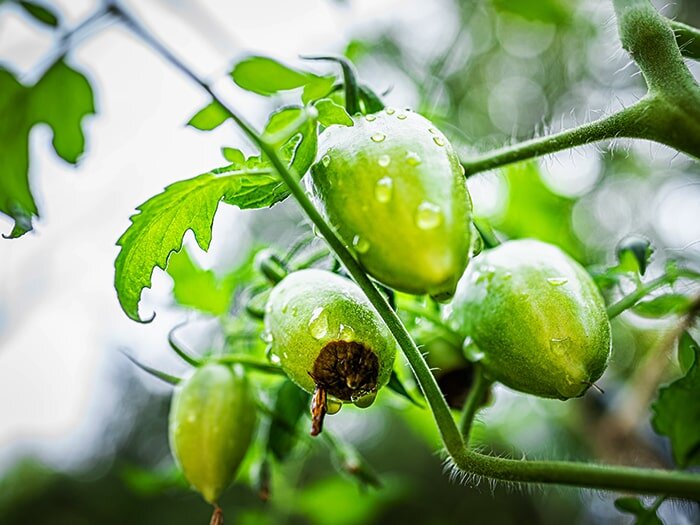
Blossom. End. Rot. Those three little words can invoke fear and anger in many vegetable gardeners. It can affect tomatoes, squash, eggplant, and even cucumbers. If you notice a soft brown spot on the end of the fruit where the blossom fell off, you’ve got it. Now, while blossom end rot is a painful problem, it is not a disease, so you don’t need to worry about it traveling through your garden. However, if you have the problem in one plant, the likelihood that the cause is present for other plants is high.

What is it?
Blossom end rot is an issue where the tissue at the blossom end of a vegetable begins to break down and rot. It often starts as a small brown or black spot on the veggie bottom. As it progresses, the vegetable end will rot, wither, and turn black. If left to its own devices, blossom end rot will generally not affect the entire vegetable, but it will decrease the amount of usable veggie. Blossom end rot will not harm you and it is ok to cut off the bad part, consuming what is left.Why Does It Happen?
Most experts will tell you that blossom end rot is caused by calcium deficiency. And they would be right. While the most common thought gardeners have when they hear deficiency is a lack of something in the soil. This is rarely the case with calcium. Most soil has a fair amount of calcium in it and the plant is just trying to get to it. With this in mind, adding calcium to the ground will probably not help much if you start to see blossom end rot. A great tool for finding out exactly what your garden soil might be missing is to do a simple, pro-level soil test using Wilco's Premium Soil Test Kit for lab results in a short amount of time. It comes complete with recommendations.Read more: Wilco Professional Results Easy Soil Test Kit with Mike DarcyAll nutrients are absorbed by the roots, so if this isn’t happening, the plant will suffer. Plants that are not watered consistently have a hard time keeping a steady supply of calcium. The root system cannot absorb calcium from the soil and transfer it to the plant without water to dissolve it in. So, if you are not supplying your plants with sufficient and consistent water, they may suffer from lack of calcium absorption.
 Plants that have grown up faster than their root system can support is another reason calcium might be missing. If you are fertilizing your veggies too much or unevenly, they may grow out of their roots. Make sure you are allowing the roots to keep up with the plant by using a balanced fertilizer.
What Can You Do?
Once blossom end rot has begun on an individual vegetable, there is not much that can be done to stop it. You may be able to slow it down, but in the end, you will need to decide if the remaining healthy veggie can be salvaged for eating. Then, make sure you take steps to keep the next round of produce healthy.
Prevention is the best way to manage blossom end rot. Here are the three most important steps you can take to avoid blossom end rot in your plants:
Plants that have grown up faster than their root system can support is another reason calcium might be missing. If you are fertilizing your veggies too much or unevenly, they may grow out of their roots. Make sure you are allowing the roots to keep up with the plant by using a balanced fertilizer.
What Can You Do?
Once blossom end rot has begun on an individual vegetable, there is not much that can be done to stop it. You may be able to slow it down, but in the end, you will need to decide if the remaining healthy veggie can be salvaged for eating. Then, make sure you take steps to keep the next round of produce healthy.
Prevention is the best way to manage blossom end rot. Here are the three most important steps you can take to avoid blossom end rot in your plants:
- Use a balanced fertilizer when planting your vegetables. Adding micronutrients like soft rock phosphate or calcium are fine but usually not necessary.
TIP: If you notice you have some veggies with blossom end rot, you can also control it by using Bonide's Rot-Stop Spray. It isn't a cure, but can help correct the calcium uptake deficiency your plant is experiencing.
While blossom end rot is never a welcome challenge, it is not the end of your vegetable garden. Cutting away the bad and creating an optimal system for the plant to get calcium will mean that your chances of blossom end rot ruining your veggies will be slim to none. So, don’t throw in the towel when you see that unwanted black spot begin to grow on the bottom of your tomatoes or squash. Just get to work making sure you’re set up for success.
We would love to see your projects, use #mywilcolife on Facebook, Twitter, or Instagram and tag Wilco Stores.
ROBYN ROGERS, THE AUTHOR OF THIS BLOG IS LOCATED ON THE KITSAP PENINSULA IN WASHINGTON AND HER ADVICE IS CONSISTENT WITH THE CLIMATE THERE.

Orders
Services
About
Your Wilco Store

Store Hours
Monday to Saturday:
8 a.m. to 8 p.m.
Sunday: 9 a.m. to 6 p.m.

Need Help?
For questions or help with online orders call: (888) 78-WILCO
Limited to stock on hand. Some items may vary from photos. Because of store size limitations or geography, some items featured may not be available in all stores but will be made available by special order during sale periods at advertised prices. All sale prices listed as “dollars off” or “% off” are discounted from our regular posted shelf price, not from discounts given with specialty, bulk or pallet pricing. Reseller and Drop-shippers must contact us for pre-approval to place orders with the intent to re-distribute.
© 2025, Wilco Farm Store